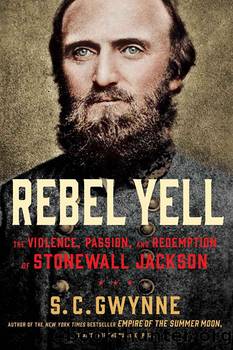
Rebel Yell The Violence, Passion, and Redemption of Stonewall Jackson by S. C. Gwynne
Author:S. C. Gwynne
Language: eng
Format: mobi
Tags: Biography & Autobiograpy, Retail, Nonfiction, Historical
ISBN: 9781451673289
Publisher: Scribner
Published: 2014-09-29T04:00:00+00:00
CHAPTER THIRTY-FIVE
VICTORY BY ANY OTHER NAME
Thus began the chase across the York-James Peninsula that became the centerpiece of the Seven Days battles. Because of McClellanâs choice of strategy, the question was not whether the Union army would be defeated but how badly it would be defeated. It was in many ways the oddest sequence of the war: a large army retreating from a smaller one, as though it could not possibly, with the resources of an industrializing nation behind it, just stand and fight. Mechanicsville and its aftermath established the model for the campaign: the Union army would wage a defensive battle by day, always on the ground of its choosing, and then retreat south toward the new base on the James River under cover of darkness. As at Mechanicsville, the rebel advance was marked by incompetence, shoddy staff work, inefficiency, miscommunication, and an almost shocking failure to take advantage of the openings McClellan gave them. In spite of this, the Seven Days was a thrilling, war-changing Confederate triumph. Leeâs, Jacksonâs, and everyone elseâs mistakes were debated and hashed over ad infinitum in the years following the war. But the indisputable fact was that the Army of Northern Virginia, under its brilliant new commander, had driven off the invader. It had saved Richmond. That was all anyone in the South needed to know. The Seven Days made Robert E. Lee famous. His generals, who did well enough, basked in borrowed light.
But the details were ugly. They got uglier as the two armies plunged southward, locked in their bloody embrace. In the Confederate camps, the fog of war was thick and deep on the morning after Mechanicsville. Though McClellan had decided to shift his base of operations the night before, Lee did not know that yet. He would not know it for certain for several days. The immense Army of the Potomac was out there, amorphous and moving through a densely wooded landscape, and because of its very immensity its contours and destination were hard to fathom. Leeâs assumption was that the Union would try to protect its supplies and would move large numbers of troops north across the Chickahominy toward White House Landing to do that. He was therefore surprised to find that Porterâs victorious 5th Corps had vanished from its camps, and had quietly fallen back three miles to a new defensive position along Boatswainâs Swamp, about half a mile from Chickahominy and two miles above the bridges they would have to use to cross the river.
While Lee remained ignorant of McClellanâs intention to change his base, he knew that he still had a Union corps in front of him and he knew that he wanted to destroy it. And he believed, incorrectly, that the railroad was still the larger armyâs Achillesâ heel. Lee thought that Porter had moved eastward behind a small stream called Powhite Creek, three and a half miles east of Beaver Dam Creek, and was waiting in a north-to-south line for him there. His plan for the next day was thus in many ways like the first.
Download
This site does not store any files on its server. We only index and link to content provided by other sites. Please contact the content providers to delete copyright contents if any and email us, we'll remove relevant links or contents immediately.
| Africa | Americas |
| Arctic & Antarctica | Asia |
| Australia & Oceania | Europe |
| Middle East | Russia |
| United States | World |
| Ancient Civilizations | Military |
| Historical Study & Educational Resources |
The Dawn of Everything by David Graeber & David Wengrow(1777)
The Bomber Mafia by Malcolm Gladwell(1673)
Facing the Mountain by Daniel James Brown(1609)
Tip Top by Bill James(1505)
Submerged Prehistory by Benjamin Jonathan; & Clive Bonsall & Catriona Pickard & Anders Fischer(1502)
Wandering in Strange Lands by Morgan Jerkins(1494)
Driving While Brown: Sheriff Joe Arpaio Versus the Latino Resistance by Terry Greene Sterling & Jude Joffe-Block(1413)
Evil Geniuses: The Unmaking of America: A Recent History by Kurt Andersen(1404)
Red Roulette : An Insider's Story of Wealth, Power, Corruption, and Vengeance in Today's China (9781982156176) by Shum Desmond(1400)
The Way of Fire and Ice: The Living Tradition of Norse Paganism by Ryan Smith(1374)
American Kompromat by Craig Unger(1369)
F*cking History by The Captain(1361)
It Was All a Lie by Stuart Stevens;(1345)
American Dreams by Unknown(1328)
Treasure Islands: Tax Havens and the Men who Stole the World by Nicholas Shaxson(1312)
Evil Geniuses by Kurt Andersen(1306)
White House Inc. by Dan Alexander(1250)
The First Conspiracy by Brad Meltzer & Josh Mensch(1224)
The Fifteen Biggest Lies about the Economy: And Everything Else the Right Doesn't Want You to Know about Taxes, Jobs, and Corporate America by Joshua Holland(1163)
